DLT Registration Charges in India: Fees and What You Actually Pay
DLT registration charges in India are set by operators, not TRAI. See the Airtel, Jio, Vi and BSNL fee position, renewal and total cost. Book a free demo.
DLT Registration Charges in India: Fees and What You Actually Pay
DLT registration charges in India are set by each telecom operator, not by the government: TRAI requires registration but publishes no fee list. Airtel's own published FAQ lists ₹5,000 plus tax, or ₹5,900 including GST, for one year, and Jio and Vi also describe annual registrations. The costs people forget are annual renewal, GST and the SMS credits you buy once your templates are approved.
This guide shows what the official sources say about DLT registration fees on Airtel, Jio, Vi and BSNL, where they stay silent, and what to budget in total, for startups, schools, clinics and retailers across India. We checked the operators' public pages on 23 October 2026. Ojiva AI runs Bulk SMS with guided DLT filing alongside WhatsApp, RCS and voice on one platform. If you want a plan sized to your own sending, book a free demo.
DLT Registration Charges in India: The Short Answer
You pay one entity registration fee to the operator whose portal you register on. Your Entity ID then works across operators, so you register once. Here is what the official documents support.
Want DLT filing handled alongside your sending plan? Talk to Ojiva AI about Bulk SMS services or book a free demo.
Who Sets DLT Registration Charges? There Is No Government Price List
The rules come from TRAI, but the price comes from the operators. That is why you will not find an official fee table on any government page, and why third-party guides quote different numbers.
DLT Registration Fees on Airtel, Jio, Vi and BSNL: What Each Operator Publishes
Only some operators publish an amount, and the documents differ in age and detail. Here is exactly what each one says. Our step-by-step DLT guide covers the filing process.
You only need to register once. Vi's FAQ says a Principal Entity registers once with any access provider to get an Entity ID, and Jio's FAQ says that ID is unique across all providers. Choose the portal with the fastest approval and the support you prefer.
Is DLT Registration Free? Why Guides Disagree
If you search for DLT registration free, you will find both answers. Because operators set their own fees, and fees have changed over time, both can appear in print.
What You Actually Pay: DLT Costs Beyond the Registration Fee
The registration fee is a small, predictable part of the bill. A simple way to budget a year of bulk SMS is: the DLT entity fee (₹5,900 including GST, once confirmed), plus SMS credits (messages multiplied by your per-message rate), plus any service charges from your provider.
Airtel's FAQ also lists a refundable ₹50,000 security deposit, but marks it as applying to telemarketers, which means SMS providers, not businesses registering as Principal Entities. Because rates depend on your plan, a written all-in quote based on your own volumes beats any rate card you find online. Ojiva AI can size one with you on a short demo call.
DLT Registration Cost for Startups, Schools, Clinics and Retailers
The entity fee is charged once per business entity, so it does not rise with the size of your campaigns. What changes from one business to the next is how much you send.
Documents, Approval Time and Re-verification to Plan For
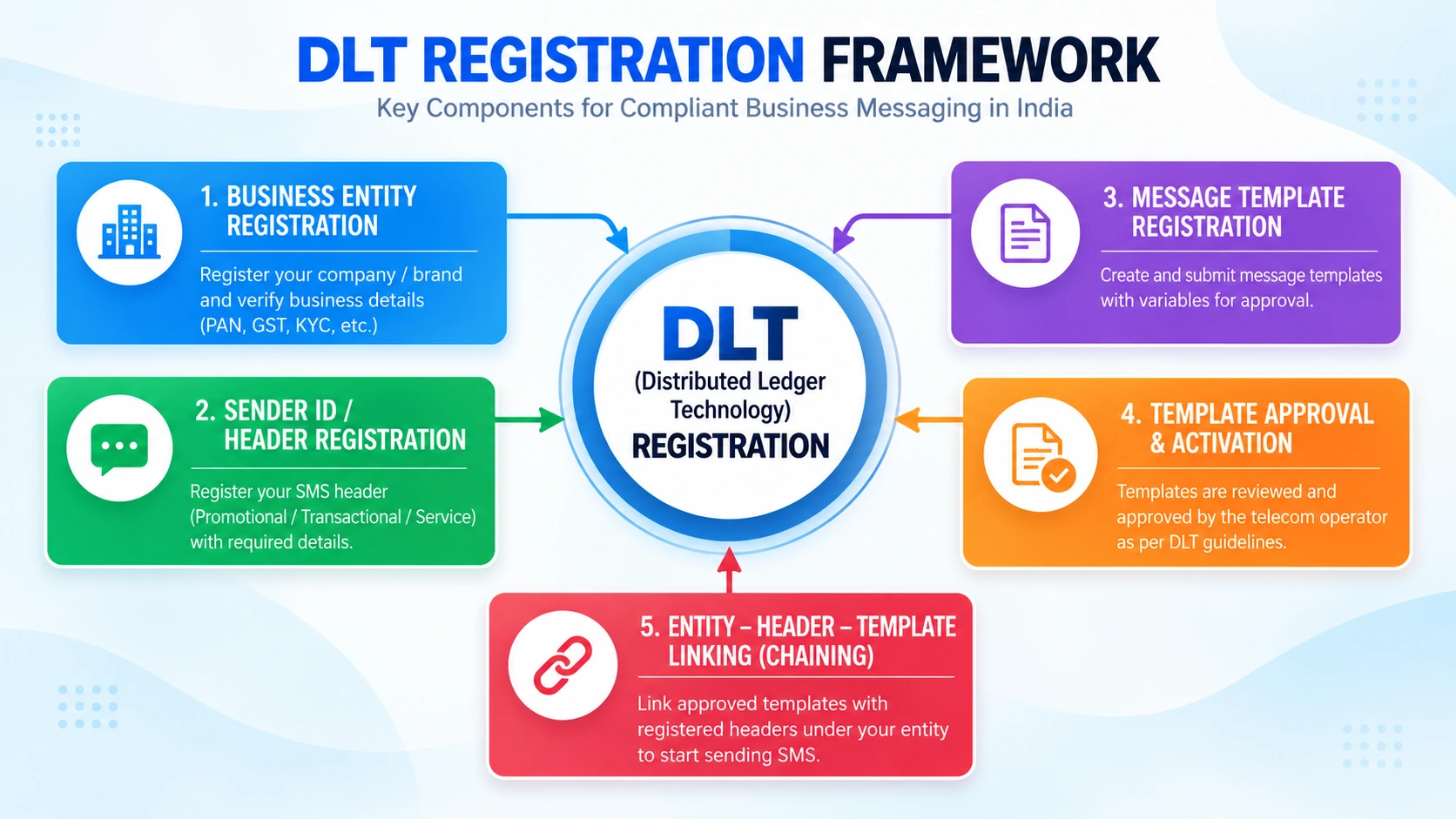
Delays can cost more than the fee itself, because no campaign can go out until your entity, header and template are approved. Get the paperwork ready before you pay.
DLT applies to SMS only. WhatsApp follows Meta's own template review instead, as we explain in WhatsApp OTP vs SMS OTP.
How to Avoid Paying More Than You Need To
Most overspending on DLT comes from a few avoidable habits. Check these before you pay anyone.
How Ojiva AI Helps With DLT Setup and Sending Costs
Ojiva AI is a Bengaluru (Bangalore) based CPaaS company and Meta Business Partner offering Bulk SMS, WhatsApp Business API, RCS, AI voice and OTP on one platform. The operator's DLT fee goes to the operator, and the rest of your cost depends on how you send. Here is how the platform maps to the checks above.
Conclusion: Budget for One Fee, Then for Sending
Treat DLT as a single annual line item set by your operator, then spend your attention on what grows with volume: SMS credits, template quality and delivery. Confirm the fee on your chosen portal, register once, keep your renewal date in view and ask every provider to itemise its charges.
To see how this works for your own message types, book a free demo with Ojiva AI and we will map your volumes, categories and DLT setup together. You can also read about our Bulk SMS services. Once you know who sets the fee and what you actually pay, DLT registration charges stop being a surprise and become a one-line budget item. Conversations that convert start with messages that get delivered.
Frequently Asked Questions
Each telecom operator sets its own fee. Airtel's published FAQ lists ₹5,000 plus tax, or ₹5,900 including GST, for a registration valid for one year, and it is non-refundable. Jio and Vi describe annual registrations too, but their public pages do not show an amount, so confirm the figure on the portal's payment screen before you pay.
No. TRAI requires entity, header and template registration, but its own guidance page lists the steps and not any amounts. Registration happens on each telecom operator's portal under that operator's Code of Practice, and the operator sets the fee. BSNL's code, for example, says charges follow its commercial terms.
Not according to the operators' own documents. Airtel's FAQ lists a paid one-year registration, and Jio's terms describe annual registration and renewal fees. Some older guides still say free, and some SMS providers absorb the fee or guide the filing at no extra service charge, which is why free DLT registration is still advertised.
Only Airtel publishes an amount on its help page: ₹5,900 including GST. Many SMS provider guides report the same figure for Jio and Vi, but the operators do not publish an amount on their public pages, and BSNL's code publishes none. Treat those as unconfirmed, and check each portal's payment screen. Since you register once, choose on approval speed and support.
Airtel's FAQ lists ₹5,000 plus tax and, in its document checklist, ₹5,900 inclusive of GST. Jio's terms state that its charges are inclusive of all applicable taxes. Check whether your SMS provider quotes its per-message rates with or without GST, so you can compare quotes on the same basis.
Many SMS provider guides report header and template registration as free once your entity is approved. The operators' own documents leave it to them: BSNL's code says header assignment and template registration follow its commercial terms. Confirm on your portal, and write templates carefully, because a rejected template delays your first campaign.
Airtel issues a registration certificate for one year. Vi lists a one-year validity with a 30-day grace period, and Jio describes annual renewal, with the registration locked until the renewal fee is paid. Set a reminder before the renewal date, because a lapsed registration can interrupt your sending.
No. Vi's FAQ says a Principal Entity needs to register only once, with any one access provider, to obtain an Entity ID. Jio's FAQ adds that the ID is unique across all access providers and can be used to register with others. Airtel says you may register with several providers using the same PAN, but you do not have to.